TWA85: 'The world's longest and most spectacular hijacking'
By Roland Hughes
BBC News
26 October 2019
IMAGE SOURCE,BANGOR DAILY NEWS
Image caption,
Airline official
Norman Kaye looks out at hijacked TWA85 at Bangor airport, Maine
At the high point of the 1960s
spate of hijackings, a plane was held up on average once every six days in the
United States. Fifty years ago this week, Raffaele Minichiello was responsible
for the "longest and most spectacular" of them, as one report
described it at the time. Could those on board ever forgive him?
21 August 1962
Under the hills of southern
Italy, a little north-east of Naples, a fault ruptured and the earth began
shaking. Those living on the surface, in one of the most earthquake-prone parts
of Europe, were used to this. The 6.1-magnitude quake in the early evening was
enough to frighten everyone, but it was the two powerful aftershocks that did
the most damage.
Twenty kilometres up from
the epicentre and a few hundred metres north was where the Minichiello family
lived, including 12-year-old Raffaele. By the time the third earthquake had
subsided, their village of Melito Irpino was uninhabitable. The Minichiello
family were left with nothing, Raffaele would later recall, and no-one in
authority came to help.
The damage was such that
almost the entire village was evacuated, razed and rebuilt. Many families would
return, but the Minichiellos decided to move to the US for a better life.
What Raffaele Minichiello
found instead was war, trauma and notoriety.
01:30; 31 October 1969
Dressed in camouflage,
Raffaele Minichiello stepped on to the plane, a $15.50 ticket from Los Angeles
to San Francisco in his hand.
This was the last stop on
Trans World Airlines flight 85's journey across the US, which had started several
hours earlier in Baltimore before calling at St Louis and Kansas City.
The crew of three in the
cockpit were helped by four young female flight attendants, most of whom had
been in the job for only a few months. The most experienced was Charlene Delmonico,
a bob-haired 23-year-old from Missouri who had been flying with the airline for
three years. Delmonico had swapped shifts to fly on TWA85 as she wanted
Halloween night free.
Before leaving Kansas City,
captain Donald Cook, 31, had informed the flight attendants of a change in the
usual practice: if they wanted to enter the cockpit, they were to ring a bell
outside the door, and not knock.
The flight landed in Los
Angeles late at night. Passengers disembarked and others, bleary-eyed, joined
the short night flight to San Francisco. The lights were dimmed so that those
who had stayed on board could continue sleeping. The flight attendants checked
the passengers' tickets when they boarded quietly, but Delmonico paid
particular attention to one of the new arrivals, especially his bag.
The tanned young man in
camouflage, his wavy brown hair flattened, was nervous but polite as he
boarded. A thin container protruded from his backpack.
Delmonico moved towards the
first-class compartment, where her colleagues Tanya Novacoff and Roberta
Johnson were guiding passengers to their seats. "What was that thing
sticking out of the young man's backpack?" Delmonico asked them. The
answer - a fishing rod - calmed her fears and she returned to the back of the
plane.
IMAGE SOURCE,GETTY IMAGES
Image caption,
TWA85, one of the
notoriously noisy Boeing 707 fleet, during the hijacking
The flight was far from
busy. With only 40 passengers on board, there was room for everyone to spread
out and seek their own row in which to sleep.
Among them were the five
mop-topped members of the sunshine pop group Harpers Bizarre, exhausted after a
strange concert in Pasadena that night that had been temporarily halted by a
man screaming from the balcony of the auditorium. It had been two years since
the band's biggest hit, an adaptation of Simon & Garfunkel's The 59th
Street Bridge Song (Feelin' Groovy), but they would hit the peak of their fame
just a few hours later.
Singer-guitarist Dick
Scoppettone and drummer John Petersen settled on the left-hand side of the
plane and, relaxing into their seats, they lit cigarettes. At 01:30 on Friday,
31 October 1969, TWA flight 85 left Los Angeles for San Francisco. Fifteen
minutes into the flight, the hijack began.
Anyone sleeping peacefully
would have had their rest disturbed on take-off. To boost the plane's thrust,
the Boeing 707 injected water into the engines as it took off, earning it the
industry nickname the Water Wagon. The effect inside the plane was violent and
noisy, producing an ominous deep rumble.
Darkness fell inside the
plane as the flight attendants turned the lights almost all the way down. As
silence settled, Charlene Delmonico began tidying the galley in the back of the
plane with Tracey Coleman, a 21-year-old languages graduate who had joined TWA
only five months earlier.
The nervous passenger in
camouflage from earlier stepped into the galley and stood alongside them. He
had an M1 rifle in his hand. Delmonico, calm and professional, responded
simply: "You're not supposed to have that." He responded by handing
her a 7.62mm bullet to prove the rifle was loaded, and ordered her to lead him
to the cockpit to show it to the crew.
IMAGE SOURCE,GETTY IMAGES
Image caption,
Charlene Delmonico
(R) demonstrates to the press how the hijacking happened, alongside Tanya
Novacoff (L) and Roberta Johnson (C)
Dick Scoppettone was
drifting off to sleep but the movement further down the aisle roused him. Out
of the corner of his eye he saw Delmonico being followed by a man who was
pointing a rifle at her back. His bandmate John Petersen turned to him from a
few rows in front and stared wide-eyed. "Is this really happening?"
Towards the back of the
plane, one of the passengers, Jim Findlay, got up to confront Minichiello. The
hijacker turned around. He shouted to Delmonico: "Halt!"
This man is a soldier,
Delmonico thought.
With Findlay ordered back
to his seat, Delmonico and Minichiello moved up the cabin again. She pushed the
curtain aside to enter the first-class compartment, her knees buckling under
the nerves, and alerted the two flight attendants ahead of her: "There's a
man behind me with a gun." They both moved quickly out of the way.
Some of the passengers
heard Minichiello shout at Delmonico as he became more and more agitated next
to the cockpit door. For the most part he was polite, respectful and came
across, in her words, as "a nice clean-cut kid", but by now paranoia
was getting the better of him.
Delmonico remembered the
captain's instruction: don't knock to enter, ring the bell instead. But
Minichiello, afraid he was being tricked, refused to let her do this. She
knocked instead, and hoped this would alert the crew. The door opened, and
Delmonico told the wary crew there was a man with a gun behind her. Minichiello
stepped inside and pointed the rifle at each of the three men inside the
cockpit: captain Cook, first officer Wenzel Williams and flight engineer Lloyd
Hollrah.
Minichiello appeared to be
well trained and well armed, Williams thought. He knew what he wanted from the
crew, and was determined to get it. After Delmonico had stepped out of the
cockpit, Minichiello turned to the crew and said in heavily accented English:
"Turn towards New York."
IMAGE SOURCE,GETTY IMAGES
Image caption,
FBI special agent
Scott Werner with the bullet handed to Charlene Delmonico
The unusual sight of a man
walking through the plane with a gun had not gone unnoticed by those passengers
who were still awake.
The members of Harpers
Bizarre had all raced to sit next to one another within seconds of the gunman
passing by. Their strange evening had just got stranger. They speculated how
the man might have been able to sneak a rifle on to the plane. Where could they
be going? Hong Kong, maybe? They'd never been to Hong Kong, that could be fun.
Nearby, Judi Provance's
training kicked in. An off-duty TWA flight attendant, she was returning home to
San Francisco after eight days on rota flying around Asia. Every year, she and
TWA staff would undertake training in how to respond during emergencies, including
hijackings. The main lesson they had been taught was to stay calm. Another was
to not fall in love with the hijacker - it was easy, they had been told, for
hijackers to elicit sympathy from the crew.
Provance quietly mentioned
to those around her that she had seen someone walking down the aisle with a
gun. She had been taught not to cause panic, and to help manage the situation
calmly. Jim Findlay, the man who had previously tried to intervene, was a TWA
pilot "deadheading" on board as a passenger. He found the hijacker's
bags and went through them to look for clues to his identity, and to make sure
no more weapons were on board. Only later did the passengers find rifle
magazines full of bullets.
Captain Cook's voice came
over the loudspeaker. "We have a very nervous young man up here and we are
going to take him wherever he wants to go."
As the flight moved further
and further from San Francisco, other messages were communicated to the
passengers, or started spreading among them: they were heading to Italy,
Denver, Cairo, Cuba. The crew inside the cockpit feared for their lives, but
some of the passengers felt they were part of an adventure. An odd one, but an
adventure nevertheless.
It was only natural that
people on board TWA85 thought they might be heading to Cuba. It had long been
hijackers' destination of choice.
From the early 1960s, a
number of Americans disillusioned with their homeland and entranced by the
promise of a communist ideal had fled to Cuba following Fidel Castro's
revolution. As American planes did not normally fly to the island, hijacking
gave people the means of getting there. And by accepting hijackers from the US,
Castro could embarrass and annoy his enemy while demanding money to return the
planes.
A three-month period in
1961 heralded the start of the hijacking phenomenon. On 1 May, Antulio Ramirez
Ortiz boarded a National Airlines flight from Miami under a false name, and
seized control of the plane by threatening the captain with a steak knife. He
demanded to be flown to Cuba, where he wanted to warn Castro of a plot to kill
him that had been wholly imagined by Ramirez.
Media caption,
Brendan I. Koerner:
"There was a lot of rage around. It was a way for people to act out."
Two more hijackings
followed over the following two months, and the next 11 years saw 159
commercial flights hijacked in the United States, Brendan I Koerner writes in
his book The Skies Belong To Us: Love and Terror in the Golden Age of
Hijacking.
Hijackings that ended in
Cuba were so common, he writes, that at one point US airline captains were
given maps of the Caribbean and Spanish-language guides in case they had to
unexpectedly fly to Havana. A direct phone line was set up between Florida air
traffic controllers and Cuba. And there was even a suggestion that a replica of
Havana's airport be built in Florida, to fool hijackers into thinking they had
reached Cuba.
The hijackings were able to
happen because of a lack of security at airports. There was simply no need to
check passengers' luggage because no-one had ever caused any trouble, until the
hijackings began. For years after that, the airline industry resisted
introducing checks because they feared it would ruin the passenger experience
and slow down the check-in process.
"We lived in a
different world," Jon Proctor, a gate agent with TWA at Los Angeles
International Airport in the 1960s, told the BBC. "People didn't blow up
airliners. If anything, they might hijack an airliner and want to go to Cuba,
but they didn't try to blow up an airliner."
It would later emerge that
Raffaele Minichiello had disassembled his rifle and carried it on to TWA85 in a
tube, before putting the gun back together in the plane's bathroom. Taking it
on board would have been "very easy", Proctor said. Gate agents would
only have weighed his backpack and not checked it.
By the time TWA85 was held
up, there had already been 54 hijackings in the US in 1969, the Associated
Press reported at the time, at a rate of one every six days. But no-one had
ever hijacked a plane in the US and taken it to another continent.
The crew were getting mixed
messages from their jittery passenger: he wanted to go to New York, or maybe
Rome. If their destination was to be New York, that would be a problem: they
had enough fuel to fly only to San Francisco, so would have to stop for more.
And if they were heading for Rome, there would be an even bigger obstacle:
nobody on board was qualified to fly internationally.
Eventually, captain Cook
was allowed into the cabin to talk to the passengers. "If you've made any
plans in San Francisco," he said, "don't plan on keeping them.
Because you're going to New York."
After some negotiation,
Minichiello agreed to let the captain land in Denver to take on enough fuel to
reach the east coast. While over Colorado, Cook alerted air traffic control for
the first time that the plane had been hijacked.
The plans soon changed:
Minichiello would let the 39 other passengers get off in Denver, but he
insisted that one of the flight attendants stay on board. A small debate broke
out about who should stay. The hijacker's preference was Delmonico, whom he had
led to the cockpit at gunpoint. Cook wanted Roberta Johnson, whom he knew best
of all four attendants.
As Delmonico began writing
a manifest of all passengers on board, Tracey Coleman went up to the cockpit
with coffee for the crew. When she stepped back out, she insisted to Delmonico:
"I'm gonna go." Coleman had a boyfriend in New York, she said, and
could go and see him. But Delmonico knew New York would not be the final
destination. "You're not going to stay in New York," she told
Coleman. "He can't stay there, he'll be arrested if he gets out there.
He's going somewhere else - I don't know where, but he's going somewhere
else."
Coleman, in an interview
with TWA Skyliner magazine after the hijacking, said she knew what was at
stake. "It wasn't because I just wanted to go along for the ride,"
she said. "But it was feared that if one of the stewardesses didn't stay
aboard, he may not let the passengers off in Denver."
Minichiello had demanded
that the lights at Denver's Stapleton International Airport be turned off as
the plane landed. He didn't want any surprises, and promised to release the
passengers only if there was no trouble.
His nerves apparently
calming, the hijacker proved unexpectedly accommodating. While he was exiting,
Jim Findlay, the deadheading TWA pilot, realised he had left behind a Halloween
outfit he had bought in Hong Kong. Findlay asked Minichiello if he could return
to the back of the plane to retrieve it. He politely replied: "Sure."
As the passengers filed off
the plane in cold, foggy weather with sunrise still two hours away, they were
met by an unsmiling FBI agent in an overcoat. The relief among those allowed to
leave was clear, and they were led down a darkened corridor through the
terminal. At the end was a room swarming with FBI agents, who had rushed to the
airport at short notice and were waiting to take statements from the 39
passengers and three flight attendants.
IMAGE SOURCE,DENVER POST/GETTY IMAGES
Image caption,
Harpers Bizarre,
pictured at Denver airport after the hijacking, said it was their best
publicity ever
The members of Harpers
Bizarre remembered what their manager had once told them: if they were ever
involved in any trouble, anything at all, they were to call him first, even
before they got to a police station or hospital. As soon as they reached the
terminal, they did just that, even though it was the middle of the night where
he lived.
The tactic paid off. When
they had finished giving their statements, they stepped into another room and
were greeted by the flash of camera bulbs, reporters shouting the band's name,
and phones ringing as news outlets around the US hoped to hear their story.
"It was the best publicity we ever had, by a mile," Dick Scoppettone
told the BBC.
The assembled photographers
captured tired passengers slumped against walls. Other passengers smiled,
bemused, as they recounted what had happened. The three flight attendants gave
statements to the FBI, and Charlene Delmonico's ran to 13 handwritten pages.
After a day of interviews,
all the flight attendants got home to Kansas City late in the evening, as TV
channels kept viewers updated as the unlikely hijack continued.
Delmonico settled in at
home after more than a day without sleep. Late in the evening, her telephone
rang. It was the FBI, could they come around to see her? They arrived at 23:00
and handed her a photo. The image of Raffaele Minichiello looked back at her.
"Yes, that's him," she said.
It was a face she would
encounter again almost 40 years later.
The three-hour flight from
Denver passed peacefully. Minichiello, stretched out in first class with the
gun at his side, had calmed down. He poured himself an unusual cocktail from
two miniature bottles - Canadian Club whisky and gin. Only five people remained
on board TWA85 - captain Cook, first officer Wenzel Williams, flight engineer
Lloyd Hollrah, flight attendant Tracey Coleman and the hijacker himself.
The plane landed at John F
Kennedy airport late in the morning, and was parked as far from the terminals
as possible. The order from the cockpit, like in Denver, was for as few people
as possible to approach the plane. But the FBI was ready, and keen to stop the
hijacker before he set a dangerous precedent and took a domestic flight to
another continent. Close to 100 agents were waiting for TWA85, many disguised
as mechanics hoping to sneak on board.
Within minutes of the
landing, as refuelling was about to take place, the FBI started approaching the
plane. Through the cockpit window, Cook spoke to one agent who wanted a
reluctant Minichiello to come closer to the window to speak to them.
"Raffaele was running
up and down the aisles to make sure they weren't trying to sneak in the
airplane," Wenzel Williams told the BBC 50 years on. "He felt he
would be shot if he came to the window."
The captain, one eye on his
passenger, warned the agents to stay away from the plane. Soon afterwards, a
shot rang out.
IMAGE SOURCE,BANGOR DAILY NEWS
Image caption,
TWA85 later in the
journey, with its new captain on board
The accepted version of
events now is that Minichiello did not intend to shoot. In his agitated state,
just outside the cockpit door, he is thought to have nudged the trigger of his
rifle with his finger. The bullet pierced the ceiling and glanced off an oxygen
tank, but did not penetrate it or the plane's fuselage. Had it damaged the
fuselage, the plane would not have been able to fly on. Had it pierced the
oxygen tank and caused an explosion, there might not have been a plane, or
crew, left to fly.
Even though the shot had
apparently been fired by accident, it sent shivers through the crew and they
were reminded that their lives were at stake. Captain Cook - who was sure the
rifle had been fired on purpose - shouted at the agents through the window,
chastising them and telling them the plane was leaving immediately, without
refuelling.
Two TWA captains of 24
years' experience who were allowed to fly internationally, Billy Williams and
Richard Hastings, pushed their way through the FBI agents and onto the plane.
Everyone else stayed on board.
"The FBI plan was
damned near a prescription for getting the entire crew killed," Cook later
told the New York Times.
"We sat with that boy
for six hours and had seen him go from practically a raving maniac to a fairly
complacent and intelligent young man with a sense of humour, and then these
idiots... irresponsibly made up their own minds about how to handle this boy on
the basis of no information, and the good faith we had built up for almost six
hours was completely destroyed."
The two new pilots, who
were in no mood to humour the hijacker, took charge of the plane. Minichiello
ordered everyone else to stay inside the cockpit with their hands on their
heads.
The plane took off quickly,
with nowhere near enough fuel on board to reach its intended destination: Rome.
Twenty minutes after the
plane had left New York with a bullet lodged in its roof, the tension on board
had eased, thanks largely to Cook convincing Minichiello that the crew had
nothing to do with the chaos at Kennedy airport.
The events there meant the
plane had been unable to refuel, so within the hour, TWA85 landed in the
north-eastern corner of the US in Bangor, Maine, where it took on enough fuel
to cross the Atlantic. By now, in the early afternoon, the story of the
hijacking and the drama in New York had gained the full attention of the
American media. Photographers and reporters turned out en masse at Bangor's
airport terminal.
Close to 75 police officers
ensured the press stayed as far as possible from the plane in case the gunman
was provoked again. Hundreds of people had driven to the airport to get a
glimpse of the action, but were kept half a mile away from the terminal. From the
plane, the hijacker spotted two people watching from a nearby building. Cook,
eager to leave, radioed the control tower: "You had better hurry. He says
he is going to start shooting at that building unless they get a move on."
The two men quickly left.
On board, as the plane
headed towards international airspace, a sense of solidarity had begun to
develop among those who had been together for more than nine hours. But under
the surface, even as they tried to keep the hijacker happy, the crew continued to
fear for their lives.
With the new pilots on
board, Cook went to sit with Minichiello in the first-class compartment, where
they swapped stories. Cook spoke of his time as an air traffic controller with
the US Air Force. The rifle rested between them, but at no point did the crew
try to take it, mostly out of concern over how the hijacker might react.
Minichiello repeatedly
asked Cook if he was married. He replied that he was, despite being a bachelor.
"That seemed wiser," Cook told the New York Times later. He had
assumed a jittery man with a gun would be less likely to harm married crew.
"He asked how many kids I had and I said one. Then he asked about the
other members of the crew and I said: 'Yeah, all of them are married.'" In
fact, only one of the four original crew members was married.
Tracey Coleman, too, spent
time chatting to Minichiello during the transatlantic trip, the first time she
had left the United States or flown for longer than four hours. He taught her
card games including solitaire and he was "a very easy fellow to talk
to", she would later recall. He talked about his family moving to the US
and, intriguingly, said he had "had a little military trouble after coming
back to the States and just wanted to go home to Italy", Coleman later
told an airline industry magazine.
She slept a little during
the six-hour flight from Bangor to Shannon, on Ireland's west coast, where
TWA85 refuelled once more in the middle of the night. Few others on board were
able to sleep. "We were too keyed up for that," Wenzel Williams
recalled. The only food on board was a handful of cupcakes left on the original
flight from Baltimore to Los Angeles. "Food wasn't exactly much of an
issue," Williams told the BBC. "Having a gun pointed at us a good bit
of the time kept most other issues at bay."
As TWA85 crossed time zones
on its approach to Ireland, and 31 October became 1 November, Minichiello
turned 20. No-one celebrated.
Half an hour after landing
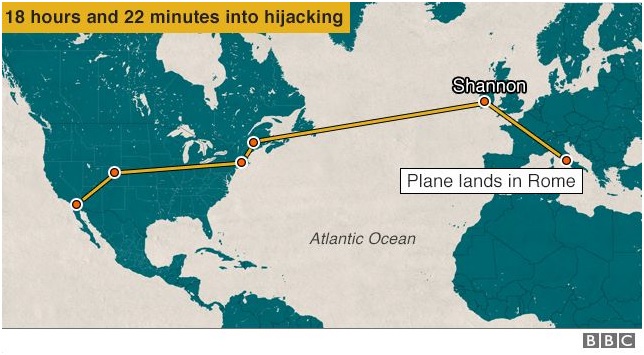
in Ireland, TWA85 was off again, on the final stretch of its 6,900-mile
(11,000km) journey to Rome.
TWA85 circled Rome's
Fiumicino airport early in the morning. Minichiello had one more demand: the
plane was to be parked far from the terminal and he was to be met by an unarmed
police official. The hijack was nearing its end, 18-and-a-half hours after it
had started over the skies of central California. It was, the New York Times
reported at the time, "the world's longest and most spectacular
hijacking".
In the last few minutes of
the flight, Williams said, the hijacker offered to drive the crew to a hotel
once they had landed, an offer they politely declined. Minichiello also feared
the crew would be punished for not having stolen his gun when they had the
opportunity. "I've given you guys an awful lot of trouble," he told
Cook. "That's all right," the captain replied. "We don't take it
personally."
At the airport, shortly
after 05:00, a lone Alfa Romeo approached the plane. Out of it emerged Pietro
Guli, a deputy customs official who had volunteered to meet the hijacker. He
walked up the steps to the plane with his hands up, and Minichiello emerged to
meet him.
"So long, Don,"
the hijacker told the captain as he left. "I'm sorry I caused you all this
trouble." Minichiello noted Cook's address in Kansas City so he could later
write to him and explain what had happened after they separated.
The two men walked down the
steps towards the car, Minichiello still holding his rifle, and the six people
on board felt "total relief", according to first officer Wenzel
Williams. They were free again. But they all hoped the next stage of the
hijacking would end safely, for both Minichiello and his new hostage.
After Los Angeles, Denver,
New York, Bangor, Shannon and Rome, there was only one destination now.
"Take me to Naples," Minichiello ordered Pietro Guli. He was heading
home.
Four police cars trailed
the Alfa Romeo and the officers' voices crackled over the hostage's radio.
Minichiello, sitting in the back seat, switched off the radio and gave his
hostage directions where to go.
IMAGE SOURCE,AFP/GETTY IMAGES
Image caption,
Police searched the
countryside outside Rome for Raffaele Minichiello, with little luck
In the countryside about
six miles from the centre of Rome, having somehow evaded the pursuing cars, the
Alfa Romeo travelled down lanes that became ever more narrow. Eventually it
reached a dead end and both men stepped out of the car. Realising he had few
options left, Minichiello sprinted away in panic.
Twenty-three hours after
TWA85 left Los Angeles, Minichiello's journey came to an end. It did so only
because of the publicity the hijacking had generated. Over five hours in the
hills around Rome, hundreds of police officers, some with dogs and helicopters,
led the search for the hijacker. But in the end, he was found by a priest.
Saturday, 1 November was
All Saints Day, and the Sanctuary of Divine Love was full for morning Mass.
Among the well-dressed congregation, the young man in his vest and undershorts
stood out. Minichiello had sought shelter in the church after shedding his
military clothes and stashing his gun in a barn. But his face was now famous
and the vice-rector, Don Pasquale Silla, recognised him.
When the police finally
surrounded Minichiello outside the church, he expressed bemusement -
interpreted by reporters as the arrogance of a young criminal - that his
countrymen might want to detain him. "Paisà [my
people], why are you arresting me?" he asked.
IMAGE SOURCE,AFP/GETTY IMAGES
Image caption,
Minichiello under
arrest in Rome: "What plane? I don't know what you're talking about"
He employed the same tone
hours later while speaking to reporters, his hands free of cuffs, after a brief
interrogation in a Rome police station. "Why did you do it?" one
reporter asked. "Why did I do it?" he replied. "I don't know."
When another asked him about the hijacked plane, he replied in a perplexed
tone: "What plane? I don't know what you're talking about."
But in another interview,
he revealed the real reasons for the hijack.
As the news of
Minichiello's arrest spread around the world later that day, Otis Turner sat
down for breakfast in the mess of his Marine barracks in California.
The television in the
corner was relaying the details of the daring hijack and the manhunt in the
Italian countryside. "Then they flashed up Raffaele's picture,"
Turner told the BBC. "I was just floored, absolutely floored."
The two men had served in
the same platoon in Vietnam. "I was confused at first," Turner said,
"but when I really got to thinking about it, I knew he had had some issues
and it all came together."
When the hijacking
happened, it was four-and-a-half years since US combat forces had first landed
in Vietnam and the fall of Saigon was still more than five years away. The US
would leave Vietnam having completely failed in its mission, leaving more than
58,000 American service personnel and millions of Vietnamese - both combatants
and civilians - dead.
Opposition in the US to the
war was at its peak in late 1969. An estimated two million people across the US
had taken part in the Moratorium to End the War in Vietnam - reported as the
biggest demonstration in American history - two weeks before the hijacking.
The lottery drafting young
Americans to fight was still a month away from being enforced, but many
thousands of young men had already volunteered, believing back then that the
cause - to fight the communists of North Vietnam - was valid. Raffaele
Minichiello was one of those who volunteered.
IMAGE SOURCE,RAFFAELE MINICHIELLO
Image caption,
Raffaele Minichiello
in Vietnam
In May 1967, the 17 year
old left his home in Seattle, to where he and his family had moved after the
earthquake in their Italian homeland in 1962. He travelled to San Diego to
enlist in the Marine Corps, and for those who knew him - a little stubborn, a
little gung-ho - this did not come as a surprise.
Minichiello barely spoke
English, and had been teased for his thick Neapolitan accent by his classmates
before dropping out of school altogether. Doing so had brought an end to his
ambitions of being a commercial pilot. But he was proud of his adopted country,
and was willing to fight for it in the hope it would make him a naturalised
American citizen.
Otis Turner arrived in
Vietnam at about the same time as Minichiello, and they served in different
squads in the same Marine platoon. They were "grunts" - the men
dropped on to the jungle-cloaked hills of the front line for a few months at a
time to take the fight to the communist forces.
"Anybody will tell
you: the grunts had the toughest job in the Marine Corps," Turner, now
living in Iowa, said. "We were in 120-degree (49C) weather, in monsoon
season. It was terrible."
In 2019, Turner looks back
with some shame at what they were ordered to do, and how they complied. Their
mission was brutally simple. "From the time we joined the Marine Corps, we
were basically all about kill, kill, kill," he said. "That's all they
wanted us to do. They drilled that into us from the beginning."
Minichiello's role brought
him into firefights that killed close friends, and led him to save others who
were in danger. He was awarded the Cross of Gallantry, which was given out by
the government of South Vietnam to those who had displayed heroic conduct in
the war.
Adjusting to daily life
back in the US proved impossible. "There was no staging area to regroup or
to get your mind and body back working as one unit," Turner told the BBC.
"There was no period there just to break it all down and think about what
you had just done, to see a professional.
"There were a lot of
sick people, confused people. Raffaele was in some state. All of us were
confused when we left Vietnam."
Turner said most members of
his and Minichiello's platoon - including himself - went on to be diagnosed
with post-traumatic stress disorder (PTSD). The US Department of Veterans
Affairs estimates that up to 30%
of all those who served in Vietnam have suffered PTSD at
some point in their lives - about 810,000 people.
Raffaele Minichiello would not
be diagnosed until 2008. He remains ineligible for treatment having received a
"less than honourable" discharge by the military, a decision his
platoon is still campaigning to reverse.
Tracked down by reporters
near Naples, Minichiello's father - who was by then suffering from terminal
cancer and had returned to Italy - knew immediately what had caused his son to
hijack the plane. "The war must have provoked a state of shock in his
mind," Luigi Minichiello said. "Before that, he was always
sane." He vowed to clip him around the ear when he next saw him.
IMAGE SOURCE,ALAMY
Image caption,
Maria Minichiello,
Raffaele's mother, cries outside court in Rome, to where she had travelled from
the US
Another reason for the
hijacking soon emerged. While in Vietnam, Minichiello had been sending money to
a Marines savings fund. He had collected $800, but when he returned to base in
Camp Pendleton, California, he noticed there was only $600 in his account. It
was not enough to pay for a visit to Italy to see his dying father.
Minichiello raised his
concerns with his superiors, and insisted he be given the $200 he felt he was
owed. His superiors didn't listen, and dismissed his complaint. And so
Minichiello took matters into his own hands, albeit clumsily. One night, he
broke into the store on the base to steal $200 of goods. Unfortunately for him,
he did so after drinking eight beers and fell asleep inside the store. He was
caught the next morning.
The day before he hijacked
TWA85, he had been due to appear before a court martial in Camp Pendleton but,
fearing prison, he went awol and travelled up to Los Angeles. With him, he took
a Chinese rifle he had registered as a war trophy in Vietnam.
Against the odds,
Minichiello became a folk hero in Italy, where he was portrayed not as a
troubled gunman who had threatened a planeload of passengers, but as a
fresh-faced Italian boy who would do anything to return to the motherland. He
faced trial in Italy - the authorities there insisted on this within hours of
his arrest - and would not face extradition to the US, where he could have
faced the death penalty.
At his trial, his lawyer
Giuseppe Sotgiu portrayed Minichiello as the poor victim - the poor Italian victim
- of an unconscionable foreign war. "I am sure that Italian judges will
understand and forgive an act born from a civilisation of aircraft and war
violence, a civilisation which overwhelmed this uncultured peasant."
IMAGE SOURCE,AP
Image caption,
The promise of a
nude modelling career for Minichiello came to nothing
He was prosecuted in Italy
only for crimes committed in Italian airspace, and sentenced to
seven-and-a-half years in prison. That sentence was quickly reduced on appeal,
and he was released on 1 May 1971.
Wearing a brown suit, the
21 year old stepped out of the Queen of Heaven prison near the Vatican to face
crowds of photographers and cameramen. Occasionally overawed by the attention
and breaking into a smile that flitted from nervousness to cockiness, he
stopped to speak to reporters. "Are you sorry for what you did?" one
asked. "Why should I be?" he replied, grinning.
But after that, an array of
prospects came to nothing. A nude modelling career never took off, and a
promise by a film producer to turn Minichiello into a Spaghetti Western star
was never kept. For years, rumours swirled that the character John Rambo was
based on Minichiello - after all, Rambo was a decorated but misunderstood
Vietnam veteran who had lost the plot - but the man who created Rambo has since
dismissed the suggestion.
In the years after prison,
Minichiello settled in Rome where he worked as a bartender. He married the bar
owner's daughter, Cinzia, with whom he had a son. At one point he also owned a
pizza restaurant named Hijacking.
23 November 1980
The earthquake that had
destroyed Raffaele Minichiello's hometown in 1962 was just a precursor.
Eighteen years later, a magnitude-6.9 earthquake struck southern Italy, its
epicentre barely 20 miles from the one in 1962.
This was the most powerful
earthquake to strike Italy in 70 years, and it caused enormous damage across
the Irpinia region. Up to 4,690 people were killed and 20,000 homes - many of
them in a weakened state after the 1962 quake - were destroyed.
IMAGE SOURCE,GETTY IMAGES
Image caption,
A village that was
destroyed in the 1980 Irpinia earthquake
Soon afterwards, Italians
began arriving in large groups to the region east of Naples to distribute aid.
Among them was Raffaele Minichiello.
The 31 year old was still
living in Rome at the time, but had felt compelled to make the 300-mile trip
home three times in only two weeks to deliver aid. "I know all about
earthquakes in Irpinia," he told an interviewer from People magazine in
December 1980. "That is where I was born, and that is where all my
troubles began."
His distrust of authority,
fostered during his time in the Marines, had stayed with him. "I mistrust
institutions, so I give help personally," he said. "I know all about
people who don't keep their promises."
Minichiello was recognised
among the snowy ruins of Irpinia, but he was not quite the minor celebrity he
had been when TWA85 landed in Rome 11 years earlier. At that time, his image -
slick curled hair, cigarette in his right hand, casual smirk on his face - had
been on the front covers of magazines around the world.
IMAGE SOURCE,ALAMY
Image caption,
Minichiello, seen
here in the court building, concocted an even more outlandish plot in 1985
In the post-earthquake
ruins, a more repentant Minichiello began to emerge. "I'm very different
now to who I was," he said. "I'm sorry for what I did to those people
on the plane."
Minichiello's redemption
did not come with the Irpinia earthquake. And his story could have ended very
differently had his plan for another attack come to fruition, although this
plan was much more poorly thought-out than his hijack.
In February 1985, Cinzia
was pregnant with the couple's second child. After being admitted to hospital
in labour, she and her newborn son died as a result of medical malpractice.
Minichiello, feeling angry and let down by the authorities again, knew what he
would do. He would target a prominent medical conference outside Rome, and draw
attention to the negligence that had cost his wife and son their lives. He
arranged, via an acquaintance, to acquire guns with which he would launch a
violent revenge attack.
While he plotted,
Minichiello struck up a friendship with a young colleague, Tony, who sensed his
distress. Tony introduced him to the Bible and read him passages out loud.
Minichiello listened and, over time, decided to devote his life to God. He
called off his attack.
In 1999, Minichiello
decided to return to the United States for the first time since the hijack.
He had learned earlier that
year that there were no outstanding criminal charges against him in the US, but
his decision to abscond was not entirely without consequence. Because
Minichiello had fled a court martial, he was given what is known as an
"other than honourable discharge" by the Marines. His former platoon
comrades have been fighting to get this reduced to a general discharge, to
reflect his service in Vietnam, but they remain unsuccessful to this day.
"Raffaele was a great
Marine, a decorated Marine," fellow platoon member Otis Turner told the
BBC. "He was always the guy right out front. He would volunteer for
everything. He has saved lives. What he did for this country, his part in
Vietnam... you just don't throw somebody to the side like that."
As his platoon worked to
clear his name, Minichiello asked them to help with another mission: finding
those who were on board TWA85, so he could apologise.
8 August 2009
By the summer of 2009,
Charlene Delmonico had been retired for more than eight years after spending
her whole 35-year career as a flight attendant with TWA. Within a year of her
retirement in January 2001, the airline no longer existed after falling into
bankruptcy and being taken over by American Airlines.
Out of the blue, Delmonico
received an invitation. Would she be willing to meet the man who had once held
her up at gunpoint?
The invitation had come
from Otis Turner and other members of Raffaele's platoon. "I thought the
idea was kind of crazy," Turner said. "But I got thinking and I
thought: why not try?"
Delmonico's first reaction
to the invitation was shock. The hijacking had defined her life, and reshaped
it. Why should she meet the man who had once put a gun against her back? Her
second reaction, as a churchgoer, was different. "I was kind of
surprised," she told the BBC. "And I had a strange feeling. This was something
that had happened that was very scary and nerve-wracking - it really did get to
me.
"Then I thought: we
are taught to forgive. But I didn't know how I would receive him."
In August 2009, Delmonico
travelled the almost 150 miles south from her home to Branson, Missouri, where
Minichiello and his former platoon were holding a reunion. There she met Wenzel
Williams, the first officer on TWA85, who was the only other person to accept
the offer to meet Minichiello. Captain Cook had refused, a gesture that hurt
the one-time hijacker who believed he had developed a bond with the captain as
they had sat chatting in first class.
In a side room at the
Clarion Hotel, Williams and Delmonico sat at a round table with the platoon
members, minus Minichiello. The former soldiers presented them with a letter,
expressing what they hoped could be achieved through the meeting. Their obvious
support for Minichiello convinced Delmonico that they felt this was a man worth
fighting for.
IMAGE SOURCE,OTIS TURNER
Image caption,
Raffaele Minichiello
(far left) and Otis Turner (far right) at a reunion of their platoon
After some time,
Minichiello walked in and sat down. The atmosphere remained tense for a while.
But as more questions flowed, and Minichiello began to explain what had
happened to him, the group grew closer.
Minichiello seemed
different to Williams - smaller, more softly spoken. He appeared weighed down
by his guilt as he relived the hijacking. But his remorse appeared sincere.
"In a way, I got a
little closure, saw a different viewpoint," Delmonico said. "I
probably felt sorry for him. I thought he was very polite. But he was always
polite."
Before they left,
Minichiello handed them both a copy of the New Testament.
Inside, he had written:
Thank you for your time, so
much.
I appreciate your forgiveness
for my actions that put you in harm's way.
Please accept this book, that
has changed my life.
God bless you so much, Raffaele
Minichiello.
Underneath, he added the
words Luke 23:34.
The passage reads:
"Father, forgive them; for they do not know what they are doing."
++++++++++++++++++++++++++++++++++++++++++
https://www.grunge.com/250539/historys-craziest-plane-hijackings/
~~~~~~~~~~~~~~~~~~~~~~~~~~~~~~~~~~~~
Full post disclaimer in left column. PCN Home Page is located at: http://pcn.homestead.com/home01.html